
Evaporator Coil vs Condenser Coil
The evaporator coil absorbs heat from indoor air, while the condenser coil releases that heat outdoors. Call (469) 369-0748 to arrange an inspection if cooling has dropped; we can check the indoor coil and see whether cleaning is relevant.
Need help now? (469) 369-0748
Evaporator Coil vs Condenser Coil: Where Each One Works
In a typical split-system air conditioner, the evaporator coil sits in the indoor air handler or furnace cabinet, and the condenser coil wraps around the outdoor unit. They are two parts of one cooling cycle, but they do different jobs. Knowing which coil you are looking at helps you describe the problem without opening the equipment.
Evaporator coil: indoor heat absorption
Warm air from the home passes across this indoor coil. The coil absorbs heat, and the blower sends cooled air back through the ducts. A dirty or iced-over evaporator coil can restrict airflow or reduce heat transfer.
Condenser coil: outdoor heat release
The outdoor unit’s condenser coil releases heat removed from the home into the outside air. Leaves, grass, and other debris packed against the coil can interfere with airflow around the unit.
The coils work as a pair
A problem at either coil can affect overall cooling, so a symptom such as warm supply air does not identify the faulty part by itself. The indoor coil is not the outdoor coil, even though both are sometimes casually called AC coils.
Which AC Coil Should You Suspect From the Signs?
Use what you can see and feel as clues, not as a final diagnosis. The indoor coil is often behind a cabinet panel, so do not remove panels or reach inside to try to identify a fault.
- Cooling has weakened and airflow is low — Check the return-air filter first. A clogged filter can restrict airflow across the indoor coil; if the filter is clean and airflow is still weak, arrange an HVAC inspection.
- Ice appears on the indoor cabinet or nearby tubing — Turn cooling off rather than chipping at the ice or continuing to run the system. A frozen coil can follow restricted airflow or another system problem, so have a technician check it after it thaws.
- The outdoor unit is running but heat lingers indoors — Look from a safe distance for leaves or grass blocking the outdoor unit’s sides. Clear loose debris around the unit without removing its panels or touching the coil fins.
- There is water near the indoor equipment — Water can come from more than one system issue, including a drainage problem; it does not prove the evaporator coil is dirty. Turn the system off if water is spreading and request service.
- The problem returns after a filter change — A clean filter is a useful first check, not a repair for a damaged, obstructed, or persistently dirty coil. Note whether airflow and cooling improve, then share that result with the technician.
Seven Safe Checks Before You Request Coil Service
These owner-level checks help separate a simple airflow issue from a condition that needs hands-on diagnosis. Stop if the equipment is iced, water is spreading, or you would need to open an electrical or coil cabinet.
- Set the thermostat to cooling — Check that the mode is set to cool and the set temperature is below the room temperature. Watch whether the system starts; a thermostat setting alone does not confirm that the coils are operating correctly.
- Inspect the air filter — Find the filter at the return grille or air handler and check whether dust blocks its surface. Replace a disposable filter with the correct size and direction of airflow, then note whether air from the vents improves.
- Check several supply vents — Make sure the vents are open and not covered by furniture or rugs. Compare airflow in more than one room; weak flow throughout the home points to a broader airflow concern than one closed register.
- Look for ice without opening the cabinet — Check only visible surfaces around the indoor equipment and exposed tubing. If you see ice, turn cooling off and leave the equipment closed; check later for melting, but do not scrape or chip the coil.
- View the outdoor unit from outside — Look for loose leaves, grass, or other visible blockage around the condenser. Clear loose material from the surrounding area without spraying the coil, bending fins, or taking off a panel.
- Record what the system does — Note whether the indoor blower runs, whether the outdoor unit starts, and whether cooling changes after the filter check. These observations help a technician decide what to inspect without treating one symptom as proof of a coil fault.
- Request service when the issue persists — A persistent cooling problem, recurring ice, or a coil hidden behind a cabinet calls for HVAC diagnosis. We provide evaporator coil cleaning service and can inspect whether cleaning fits the condition.
Need help now? (469) 369-0748
What Evaporator Coil Cleaning Addresses
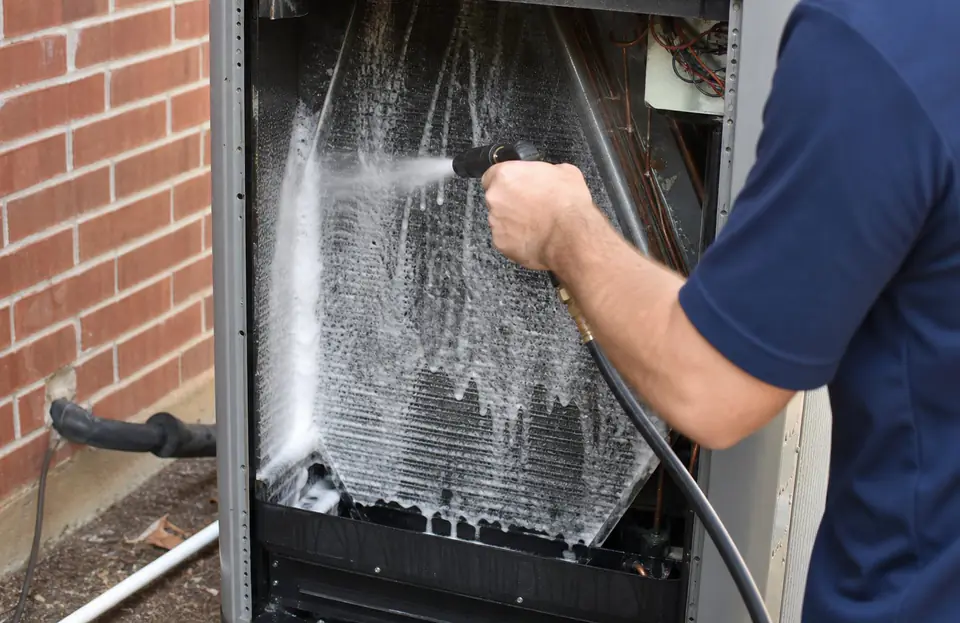
Cleaning targets buildup on the coil surface that can interfere with airflow and heat transfer. A technician needs access to the indoor coil and must use a method suited to the equipment and the coil’s condition; aggressive brushing or household chemicals can damage delicate fins or other components.
Cleaning is not the same as repairing a bent, corroded, or otherwise damaged coil. It also does not correct a blocked filter, a drainage fault, or another cause of poor cooling by itself. For a closer look at the service process, read how an evaporator coil gets cleaned.
When Coil Cleaning Fits Better Than Repair or Replacement
The right next step depends on what an inspection finds, not just on the symptom. Cleaning is appropriate when buildup is present and the coil is otherwise serviceable; visible damage or a problem that remains after cleaning calls for further diagnosis.
Consider cleaning when buildup is visible
Dust or grime on an accessible coil surface may justify cleaning, particularly when airflow and cooling have declined. The technician should assess access and coil condition before choosing a cleaning method.
Choose diagnosis when the coil is iced or cooling remains poor
Ice, weak airflow, or continued poor cooling can have causes beyond a dirty coil. A technician can check the filter, airflow, drain, and equipment condition rather than repeatedly cleaning a coil that may not be the cause.
Ask about replacement only after damage is confirmed
Cleaning cannot restore a coil that is physically damaged or otherwise no longer serviceable. Ask what was found and whether the issue is limited to the coil before comparing repair and replacement options.
Why Dallas Summer Heat Makes Coil Airflow Important
The National Weather Service Fort Worth reports a normal July high of about 95.6°F at DFW Airport for 1991–2020. Long cooling cycles in hot weather make restricted airflow at either coil more noticeable, but high outdoor temperatures alone do not mean a coil needs cleaning.
ENERGY STAR’s heating and cooling maintenance guide includes cleaning indoor and outdoor coils before the cooling season. A spring check can catch visible buildup before the hottest stretch; during summer, report recurring weak cooling or ice instead of opening the system yourself. Read more about our HVAC service in Dallas or review the AC coil cleaning cost factors.
Need help now? (469) 369-0748
What to Ask Before Approving an AC Coil Replacement
A coil replacement cost depends on the equipment and the work the repair requires, so a cleaning price cannot be used as a replacement estimate. Ask which coil is affected, what condition was found, and whether cleaning or repair is still a reasonable option.
Have the equipment information available if you can read it without removing a cover. Ask the technician to identify the finding that supports replacement and whether the proposed part matches the system. If a coil cleaning is the recommended service, ours starts from $139; that price is for cleaning, not coil replacement.
Frequently asked questions
How can I tell whether the evaporator coil or condenser coil is the problem?
The evaporator coil is indoors and the condenser coil is in the outdoor unit in a typical split system, but symptoms alone cannot confirm which part is at fault. Check the filter and visible outdoor blockage, then arrange an inspection if cooling remains weak or ice appears.
What affects AC coil replacement cost?
The affected coil, the equipment it belongs to, and the work needed to complete the replacement all affect the estimate. Have the technician identify the coil and explain why replacement is needed; our published $139 starting price is for evaporator coil cleaning, not replacement.
Can I clean an evaporator coil myself?
You can replace or clean the air filter and keep visible debris away from the outdoor unit, but the indoor coil is often behind an equipment panel. Do not open electrical compartments, scrape fins, or apply household chemicals; request service if the coil needs direct cleaning.
Should both AC coils be cleaned at the same time?
Not automatically: the indoor evaporator and outdoor condenser coils are separate components, and each should be checked for its own condition. Ask the technician which coil has buildup and what cleaning is recommended for that equipment.
Get the Coil Checked
Call (469) 369-0748 to arrange an inspection for a cooling problem or ask about evaporator coil cleaning.